Issue #3 · March 23-29, 2026 · Chaitra Śukla Pakṣa
सूर्य sūrya
Surya
= the supreme one
= name of Earthen Sun, from rising until setting
Sura - Suraja - Sarva
Happy Sunday! We are three issues in. Thank you for being here.
This week is special btw. Rāma Navamī falls on Friday, Chaitra Navarātri is in full flow and Venus changes signs. Let's get to it.
If you haven’t yet, read Issue #1 and Issue #2.
ākāśa / the week at a glance

Astrokarak Calendar for 23rd to 29th March
this week in the sky
Three main things are happening this week.
Wednesday evening: Śukra (Venus) enters Meṣa (Aries). Venus leaves its exaltation sign Pisces and enters Mars' territory. This is a shift worth noticing. In Mīna, Venus was at its most refined, intuitive, artistic. In Meṣa, Venus becomes direct, impatient, passionate. It's the difference between a poet writing in a garden and the same poet storming into a boardroom. If you've been sitting on creative decisions, relationship conversations, or financial commitments that require boldness rather than subtlety, the next few weeks favour action over contemplation. But Venus in Aries is not comfortable. It's a guest in someone else's house, and the host (Mars) prefers bluntness over beauty. Watch for impulsiveness in spending, romantic declarations that are more heat than depth, and aesthetic choices you might regret in three weeks. Rather, my advice would be to think about your actions before you perform them, at least until Venus moves to Taurus.
Friday: Rāma Navamī. Chaitra Śukla Navamī. The birth of Śrī Rāma. This falls in the middle of Chaitra Navarātri, the nine nights of Devī worship that opened this new Vedic year. Whether you observe the fast or not, there's something worth noting astrologically: Rāma Navamī consistently falls during the waxing phase of the Moon in Chaitra, often in Puṣya or a nearby nakṣatra. Puṣya is nourishment, care, expansion. Ramayana says Rāma was born at madhyāhna (midday), the peak of solar strength. The combination of a strong waxing Moon and midday Sun is not accidental. The festival encodes a sort of recreation of the picture of the akasa (sky) from the past. Did you get it?

[Recommendation: To those who are interested in knowing more about Bhagvan Ram’s birth, Ramayana, timings, how it has been mapped, check out this video of Nilesh Oak, you will find it interesting.]

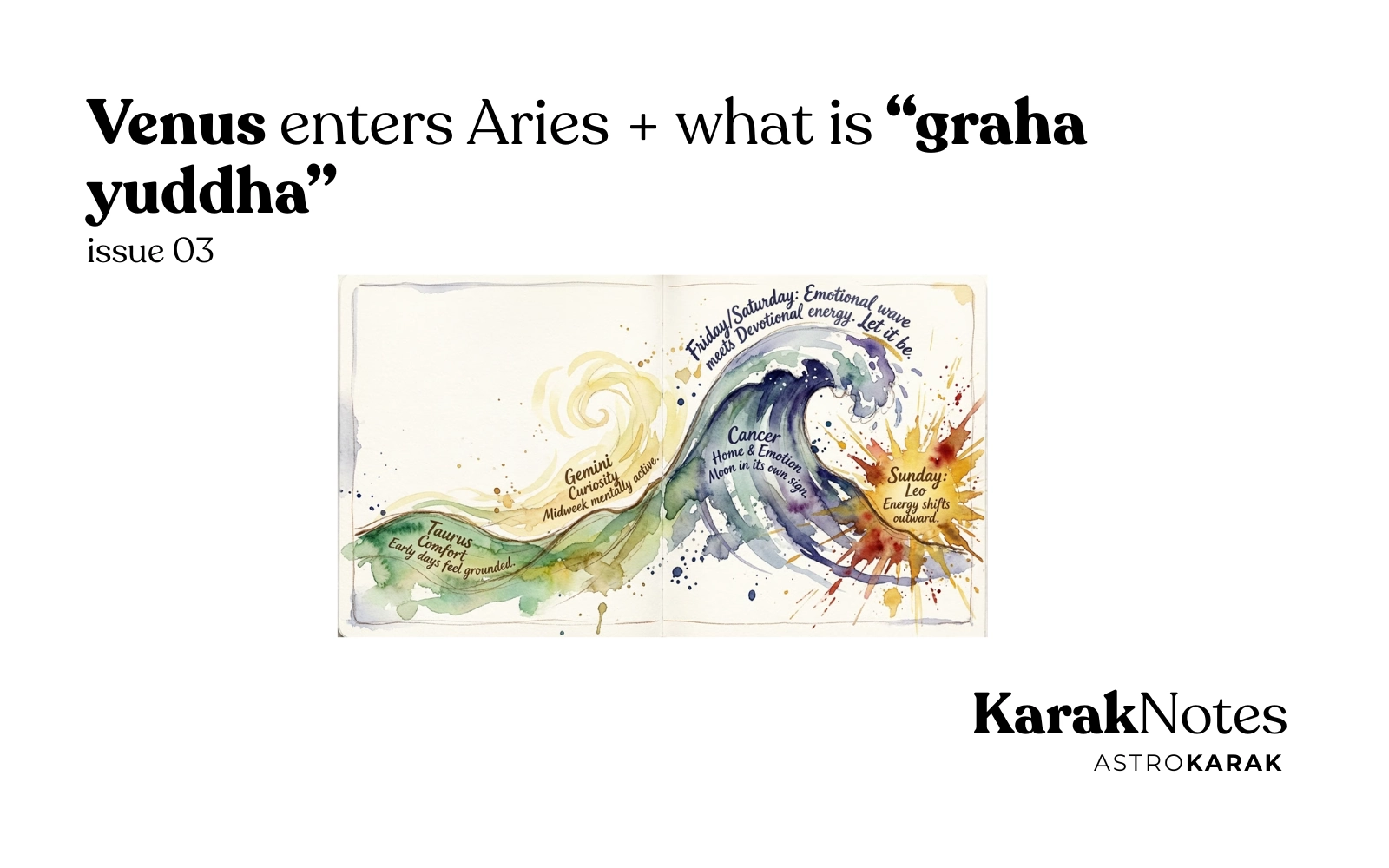
The Moon this week moves through Taurus (comfort), Gemini (curiosity), Cancer (home, emotion), and into Leo by the time you will be reading Issue #4. The emotional arc of the week builds steadily. Early days feel grounded. Midweek gets mentally active. Friday and Saturday bring a wave of feeling, especially with Moon in Cancer, its own sign, on the day of Rāma Navamī. By Sunday, Moon enters Leo and the energy shifts outward again. If you feel unusually emotional on Friday, it's the Moon in Cancer meeting the devotional energy of the day. Let it be.
Graha Yuddha: what actually happens when two planets go to war

Most people learn early in their Jyotiṣa studies that conjunctions are important. Two planets in the same sign. Their energies mix. Good. But what almost nobody teaches is what happens when a conjunction becomes a war.
Graha Yuddha, planetary war, occurs when two planets are not just in the same sign but within 1 degree of each other. At that proximity, they don't cooperate. They compete. One wins, one loses, and the loser's significations in your chart get damaged, sometimes badly.
Three rules define it:
Both planets must be in the same rāśi. They must be within 1 degree of each other (some texts allow up to 1°15'). And only the five tārā grahas can participate: Budha, Śukra, Maṅgala, Guru, and Śani. Sun and Moon are luminaries and don't enter into war (Sun can combust other planets, but that's a different mechanism). Rāhu and Ketu are shadow planets with no physical light, so they don't qualify either.
This means only five planets, in specific pairings, at an extremely close distance, produce a Graha Yuddha. It's rare. Most charts don't have one. But when it's there, it's significant.
Who wins the war?
The classical texts give two criteria. The first is brightness. Planets have inherent luminosity rankings called Naisargika Bala: Venus is the brightest (score of 43), followed by Jupiter (34), Mercury (26), Mars (17), and Saturn (9). If Venus and Saturn are at war, Venus wins almost every time simply because it outshines Saturn. The second criterion is degree: the planet at the lower degree in the sign has a positional advantage. If both factors point to the same planet, the winner is clear. If they conflict, judgement is required, and this is where an astrologer's skill comes in.
The four types of planetary war
Maharishi Parāśara, and later on, Varāhamihira, describe four intensities. Ullekha is the mildest: the planets are close, their discs nearly touching, and there's a subtle power struggle but no outright destruction. Bheda is more intense: the discs overlap, and the losing planet's significations start to suffer. Aṃśuvimarda is severe: the rays of both planets merge completely, and the defeated planet's energy is nearly erased from the chart. Apasavya is the rarest and most difficult: one or both planets are retrograde during the war, creating a looping, repetitive pattern of struggle that can play out over years.

Four Intensities of Graha Yuddha
What does the loser actually lose?
If Venus loses a war in your chart, relationships, creativity, luxury, and financial grace get impacted. If Mercury loses, communication, intellect, and analytical ability suffer. If Jupiter loses, wisdom, faith, and expansion are suppressed. The effects depend on which houses these planets rule in your specific lagna, which is why the same Graha Yuddha plays out differently for different people.
A common mistake: people see any close conjunction and panic. Mars at 8° and Jupiter at 12° in the same sign is a conjunction, not a war. The 1-degree threshold matters. Without that proximity, there is no Yuddha. Just two planets sharing a room.
If you want to check your chart, look for any two of the five tārā grahas in the same sign within 1 degree. If you find it, note which planet has the lower degree and higher brightness. That's likely your victor. The other planet's house lordships in your chart will tell you where the damage, or the forced growth, shows up.
Now, I am sure there is at least one reader wondering why did I, in my own newsletter’s calendar strip, mentioned a Mercury-Rahu graha yuddha? That is because there is an important nuance here. Varahamihira classifies all the Navagrahasinto three categories for mundane astrology purposes only:

- Paura (Civilian): Mercury, Jupiter, Saturn (always); Sun (when in the east)
- Yayi (Attacker/Marching to war): Mars, Venus, Rahu, Ketu (always); Sun (when at midheaven)
- Akranda (Attacked/Crying out): Moon (always); Sun (when in the west)
This classification includes Rahu, Ketu, Sun, and Moon, but note that this is a classification of planetary roles in mundane astrology result-interpretation, not a declaration that all 9 planets enter into Graha Yuddha. The Paura-Yayi-Akranda framework is used to determine what type of people or events are affected when a planetary war occurs - as you might remember what Mercury-Rahu GY did. Do you? If not, check the last week’s calendar strip.
from the vault
Do you ever wonder how exactly astrologers predict what is going on around the world? This week, instead of a reel, I have a post for you which will answer this question.
Mundane Astrology is all about global shifts, what’s happening in different countries, how astrologers measure it and overall, it is a great tool for geopolitics. Check it out, I have outlined an introduction to the subject.

Rāma Navamī this Friday. Venus changing signs on Wednesday. The Moon building towards fullness all week. There's a lot of energymoving, especially with what’s going on in the world. Pay attention to what shifts in your own life between Wednesday and Friday. That's where the week's story is.
If you found the Graha Yuddha explanation useful, forward this email to one person who studies Jyotiṣa, they might like it.
Jai Śrī Rām. See you next Sunday.
Best,
Pranjal
PS - If you have any topics you would like to suggest for the next week or feedback, feel free to share it byreplyingto this email. I read every single one of them.