KarakNotes Issue #5
Issue #5 · April 6 to April 12, 2026 ·
Happy Monday!
Yes, it is Monday. The newsletter was meant to go Sunday, and then Sunday happened. Some weeks the sky moves faster than the calendar. I am sure many of you may already have started your Mondays already, hope this newsletter brings some clarity into the week.
Fifteen hundred of you are reading this now, and that still genuinely surprises me each time.
Read the previous issues here: Issue #1 · Issue #2 · Issue #3 · Issue #4
ākāśa / the week at a glance

The week opens in Kṛṣṇa Pakṣa, with the Moon waning through Vṛścika and entering Dhanu early Wednesday, April 8. A Ganda Mool stretch begins with Jyeṣṭhā around 2:57 AM on Tuesday, April 7, and continues through Mūla until about 5:18 AM on Thursday, April 9.
Monday carries Sarvartha Siddhi Yoga: Anurādhā nakṣatra on a Monday, which is a genuinely good combination for undertakings requiring sustained force. Saturday carries it again: Śravaṇa nakṣatra falling on Śanivāra, which is one of the classical pairings for important focused work. Friday is Kālaṣṭamī, Śiva's aṣṭamī. If you observe any Śaiva upāsanā, Friday evening is the right day.

one concept, explained
Ṣoḍaśavarga: The Sixteen Charts Maharishi Parāśara Left Behind
Most people learn Jyotiṣa one chart at a time. The Lagna chart first: the rāśi, the D1. Then someone mentions the Navāṁśa (D9) and the picture gets more interesting. And then the list begins to grow, and somewhere around D10 or D12 it starts feeling overwhelming, and most students quietly stop.
What Maharishi Parāśara actually gave us is a system. Not a collection of charts but a coherent architecture. He calls it Ṣoḍaśavarga: the group of sixteen. Chapter 6 of Bṛhat Parāśara Horā Śāstra is dedicated entirely to these sixteen divisions of a rāśi, each one created by subdividing the 30 degrees of a sign into a specific number of equal parts. The resulting sub-signs are what we call Vargas, and each one captures a different dimension of life with a precision that the rāśi chart alone cannot achieve.
The sixteen are:
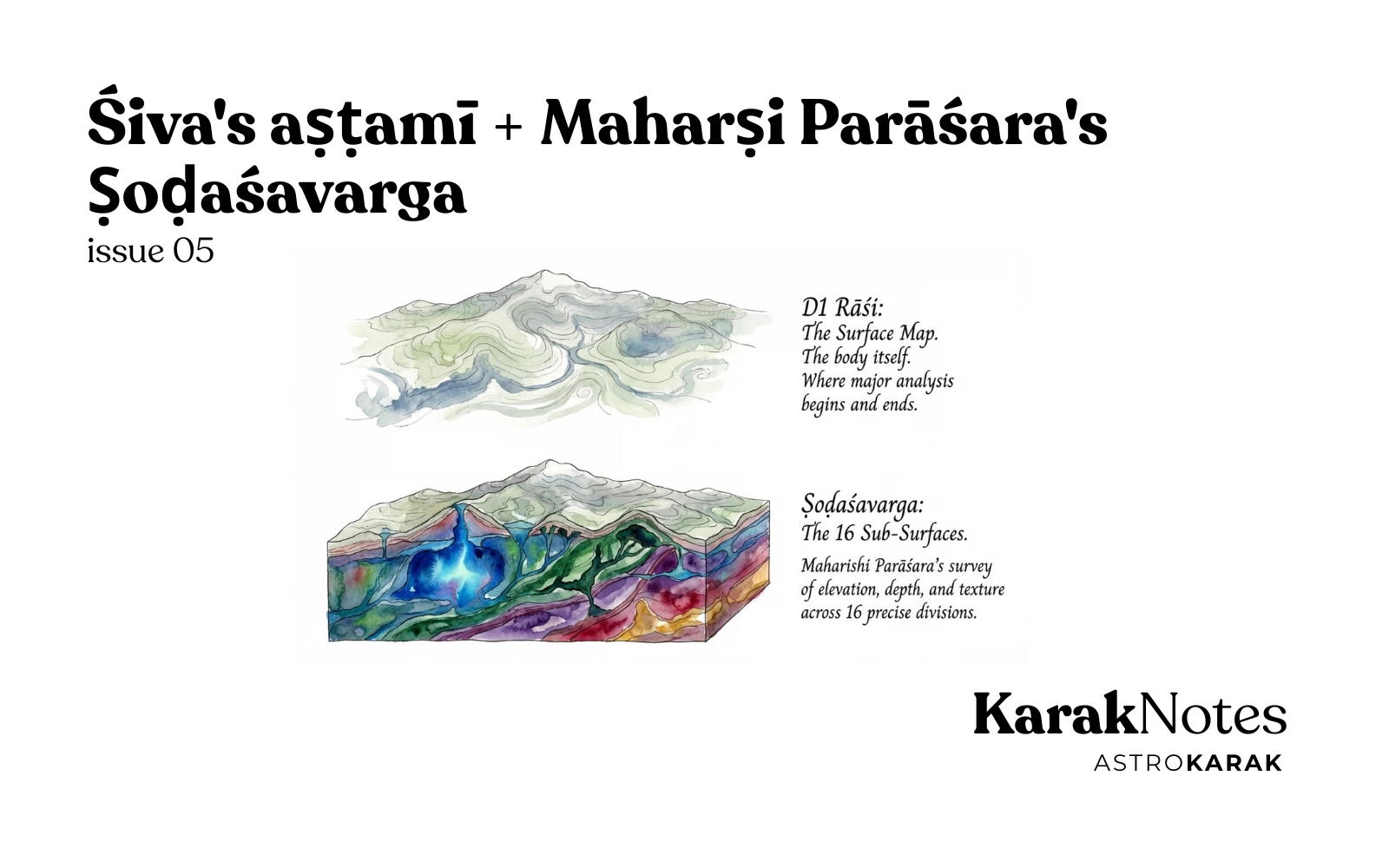
D1 (Rāśi) - the body itself. The main chart. All major analysis begins and ends here. Divisions: 1.
D2 (Horā) - financial potential and wealth. Each sign is halved into 15-degree segments. The Sun's Horā and the Moon's Horā indicate the flavour of effort required to generate wealth.
D3 (Dreṣkāṇa) - siblings, courage, valour. Each sign divided into three 10-degree segments.
D4 (Caturthāṁśa) - property, fixed assets, fortune from land. Each sign into four 7°30' segments.
D7 (Saptāṁśa) - children, progeny, creative output. Each sign into seven parts.
D9 (Navāṁśa) - the most important of all. Marriage, partnership, the deeper quality of a planet's expression. If the D1 is the body, the Navāṁśa is the soul of the chart.
D10 (Daśāṁśa) - career, profession, social status, one's contribution to the world.
D12 (Dvādaśāṁśa) - parents, lineage, ancestral karma.
D16 (Ṣoḍaśāṁśa) - vehicles, movable assets, comfort from material life.
D20 (Viṁśāṁśa) - spiritual inclinations, religious orientation, the deity one naturally gravitates toward.
D24 (Caturviṁśāṁśa) - education, learning, knowledge, vidyā.
D27 (Saptaviṁśāṁśa or Bhāṁśa) - strength and weakness, physical capacity, capacity to endure.
D30 (Triṁśāṁśa) - misfortunes, evils, the nature of suffering. A critical chart for understanding the darker structural patterns.
D40 (Khavedāṁśa) - auspicious and inauspicious effects from the mother's side.
D45 (Akṣavedāṁśa) - auspicious and inauspicious effects from the father's side.
D60 (Ṣaṣṭyāṁśa) - past life karma, the most granular of all charts. Maharishi Parāśara says the D60 carries its own independent weight and should be studied seriously alongside the D1. Each sub-division of 0°30' in D60 has its own name and quality.

Why does this matter practically? Because the rāśi chart is a map of your life's terrain, but the Vargas are the survey - they show you elevation, depth, and texture the main map cannot. A planet may look strong in D1 but miserable in D9, and that misery will tell you why its Mahādaśā underdelivers despite a good placement. A planet may look debilitated in the rāśi chart but excellent in D10, and that will tell you how someone builds a substantial career despite apparent chart difficulties.
The concept of Vimśopaka Bala - planetary strength across the sixteen charts - exists precisely because of this. Each chart in the Ṣoḍaśavarga is assigned a weight, and a planet's cumulative strength across all sixteen determines its real functional power in the native's life. The Navāṁśa carries the most weight of any single Varga (3 out of 20 in the Saptavarga system, higher in the Ṣoḍaśavarga weighting), which is why so many classical astrologers treat D9 as nearly co-equal with D1.

Two practical instructions before you close this issue. First: find the Navāṁśa sign of your Lagna lord. Whatever sign is rising in your rāśi chart, wherever that lord sits in the Navāṁśa, that position tells you how strong your Lagna lord truly is and what it is actually trying to do. A Lagna lord that looks debilitated in D1 but is exalted in D9 has a story to tell about hidden reserves. Second: find the D10 placement of your 10th lord. The career picture in the rāśi chart is the overview; the D10 is the operating detail. Both are needed to say anything useful about profession and status.
The Astrokarak Instagram has a Divisional Charts series - we are restarting it soon with more structure and depth. The blog will carry a dedicated guide to each Varga as we go. For now, most Jyotiṣa software (Jagannātha Horā is free and excellent) will calculate all sixteen charts automatically. Look at them. The D1 you have been reading all this time is one sixteenth of the picture Maharishi Parāśara actually drew.
Useful reading: The Ṣoḍaśavarga chapter is Chapter 6 of Bṛhat Parāśara Horā Śāstra. Any Girish Chand Sharma translation is reliable. I also personally translated this chapter when I was studying BPHS, I can share it in one of our next issues if anyone is interested. Additionally, here are some books you can refer to:
- Shodasha Varga: The 16 Divisional Charts of Vedic Astrology by Komilla Sutton
- Splendour of Vargas (Most Influential Divisional Charts) by Krishna Kumar
- Navamsa in Astrology by C.S. Patel
check your chart
This week: open your chart in any software that shows Vargas and find which sign your Lagna lord occupies in the Navāṁśa (D9). Note whether it is in a friendly, neutral, own, exalted, or debilitated sign. That single placement modifies everything you think you know about how your Lagna lord performs. If you want to share what you find, just reply to this email. I read every one.
from the vault
This week, instead of one reel, I want to share a series.
Over the past few weeks I created five reels using the Dhurandhar soundtrack, the music from the biggest Bollywood film of 2025, at least to me, which has just broken its own records with the sequel. The reason I chose that music is that I, being a cinephile and an avid espionage-lover, couldn’t help but appreciate the wonderful music design and overall experience of the movie. I think it has been my favourite album ever since the movie came out.
Each reel in this series covers my interpretation of different scenes synced with music of the movies. If you have been following Astrokarak for a while, some of this will feel like a recap. If you are newer, you’re in for a ride, especially with the Rahu Dev on Monica O My Darling reel. Haha.
Watch the Dhurandhar Inspired Reel series:

Reel 1 · Reel 2 · Reel 3 · Reel 4 · Reel 5
a nimitta from the week
I mentioned Nimitta in Issue #2 - signs that arise in the environment around the time of a reading, not as superstition, but as a feedback system that the classical texts take seriously. I said: when timing, atmosphere, and relevance converge, pay attention.
Yesterday I sat for two consultations. Two individuals, no connection to each other. Both turned out to be twins. Both had sisters. Two consecutive sessions, same coincidence, same structural echo. This is the kind of thing that stops you mid-reading. Not because you force meaning onto it. But because Jyotiṣa teaches you that patterns announce themselves before you arrive at the logic. I am still sitting with what that echo was pointing to.
Do you notice things like this? Reply and tell me. I am genuinely curious.
a note on community
If KarakNotes is useful to you, the single best thing you can do is forward it to one person who would get something real out of it. Not for the numbers. Because these ideas deserve to travel to people who are ready to think seriously about Jyotiṣa.
The subscribe link: astrokarak.beehiiv.com
For consultations, courses, and ebooks: astrokarak.com
See you next Sunday. On time.
Pranjal
KarakNotes by Astrokarak· Ahmedabad, India