Issue #6 · April 13 to 19, 2026 · Caitra Kṛṣṇa Pakṣa to Vaiśākha Śukla Pakṣa
Happy Monday!
Somavāra (सोमवार):, [=soma-vāra] [fromsoma]m.‘moon-day’, Monday,
Somavāra (सोमवार) refers to “monday”. The corresponding planet is soma (the moon). It is one of the seven days of the week (vāra). The term is used throughout Jyotiṣa literature.
Issue #5 brought in more replies than any issue so far, thank you. I read every one, and though it was not possible to respond to each individually given the quantity that came in, they were genuinely read and genuinely appreciated. Several of you shared your D9 Lagna lord placements. Some of those were fascinating. Keep them coming.
Read the previous issues here: Issue #1 · Issue #2 · Issue #3 · Issue #4 · Issue #5
ākāśa / the week at a glance

This is an unusually dense week and the calendar shows it clearly. I have also updated the calendar format this week to reflect our topic: Pañcāṅga, so you will now see all five panchang limbs listed for each day. I may find a better way to show calendar soon, maybe something which is interactive.

Tuesday, April 14 is Vaiśākhī -Sūrya Saṅkrānti. The Sun crosses from Mīna into Meṣa at 9:17 AM (New Delhi time). This is the moment Sūrya Dev enters the sign ruled by Maṅgal, and notably, the sign where the Sun is exalted. Meṣa is not merely a friendly sign for the Sun; it is where he reaches his highest dignity in the zodiac. Solar year calculations in many northern Indian traditions begin here. The Saṅkrānti moment, when the Sun is literally changing signs, is treated as an inauspicious window in classical texts.Avoid important initiations in the hours immediately surrounding 9:17 AM, so like 8 am to 10 am, on Tuesday. This is all IST by the way.
Friday, April 17 is Amāvāsyā. It begins at 8:11 PM on Thursday the 16th and ends at 5:21 PM on Friday the 17th. The dark Moon. Sun and Moon conjunct in Meṣa, Revatī nakṣatra transitioning to Aśvinī. No Moonrise on this day. The classical instruction for Amāvāsyā is consistent across all traditions: it is a day for Pitṛ tarpana (ancestral offerings), inner work, and releasing, not initiating. There is no Moonrise because the Moon is invisible, absorbed into the Sun. Emotionally, the day tends toward heaviness or blankness for many people. This is structural, not personal. If Friday feels flat or draining, that is the Amāvāsyā quality doing exactly what it is supposed to do.
Saturday, April 18: Śukla Pakṣa opens. The waxing fortnight begins. Pratipadā in Aśvinī. The energy shifts from the contracting, releasing quality of Kṛṣṇa Pakṣa to the building, expansive quality of Śukla Pakṣa. If you have been holding back on something until the right moment, this is the right moment.

Sunday, April 19: Śukra (Venus) enters Vṛṣabha (Taurus). His own sign. Venus has been in Aries since late March, a guest in Mars's home, which is not his natural territory. In Taurus, Śukra is sovereign. The areas Venus governs: relationships, beauty, art, financial taste, creative output, all operate more cleanly from Sunday onward. This is a good week to end on. This means you get the next newsletter on time, haha.
The Moon's arc: Kumbha (Aquarius) early Monday, crossing into Mīna (Pisces) Monday afternoon, staying in Pisces through Wednesday evening. From Wednesday night, the Moon is in Meṣa (Aries) through most of Friday. The Moon then crosses into Vṛṣabha (Taurus) on Friday evening and stays there through Sunday. Emotionally: quiet and slightly detached to start the week, then increasingly fluid and internal toward the Amāvāsyā, then a strong reset from Saturday onward with the Moon in Taurus and Śukla Pakṣa open.
predictions
The Saṅkrānti on Tuesday combined with the deepening Kṛṣṇa Pakṣa through Friday creates a week that moves from sharp solar energy early in the week to a very still dark-Moon centre.
On an individual level: the Amāvāsyā on Friday makes it one of the harder days of the week for important meetings or public-facing work: you will feel less visible and less energised, which is by design. With Śukra entering Vṛṣabha on Sunday, conversations about money, relationships, and creative direction that have felt stuck or unclear for the last few weeks may begin to loosen.
mundane notes
THE SENSITIVE PERIOD ENDS. THE VOLATILE ONE BEGINS.
The ten-day danger window (April 3 to 13) closes on the 13th. The pressure does not dissipate. It transfers directly into the April 15 to 24 window, which is more volatile.
SUN ENTERS ARIES: MEṢA SAṄKRĀNTI (VEDIC SOLAR NEW YEAR)
The Sun crosses the most sensitive junction in the zodiac: the boundary between the last water sign (Mīna) and the first fire sign (Meṣa). Weeks of watery confusion give way to fiery, decisive solar energy. The Sun becomes exalted. Sudden rise, visibility, and power return from April 14 onward.

The Meṣa Saṅkrānti chart, cast for the exact moment the Sun enters Aries, is used by Vedic mundane astrologers to forecast the coming solar year. This year's chart shows Mars, Saturn, and Mercury still clustered in Mīna (the 12th from Meṣa Lagna): hidden pressures, foreign conflicts, and losses remain dominant themes for the year ahead.
MARS APPROACHES SATURN: THE PRESSURE BUILDS DAILY
Mars closes on Saturn's exact degree through the week. Each day the energy intensifies. General atmosphere and personal stress levels rise in tandem until April 19. Sectors connected with chemicals, gases, liquids, and transport need extra caution. I had also mentioned this in the previous newsletter calendar. Structural stress, heavy accidents, and transport failures correlate historically with Mars-Saturn contacts. War energy, obstruction, and communication breakdown define the tone.
APRIL 15 to 20: THE RED-ALERT WINDOW
Mutual obstruction among Mars, Saturn, and Mercury in Mīna with Ketu in Siṃha. The ignition point: red-hot iron plunged in water. This configuration is historically correlated with sudden policy reversals, breakdown of alliances, uncontrollable street unrest, and natural plus man-made calamities occurring together. Watch for aggressive geopolitical moves, military posturing, and irreversible escalation.
APRIL 19 to 20: EXACT CONJUNCTION - GRAHA YUDDHA
Mars conjunct Saturn at approximately 12 to 13° Mīna. Mars wins the planetary war. Aggression, military force, and impulsive action triumph over Saturn's restraint, patience, and diplomacy. Mercury (debilitated) joins the exact conjunction. Three Graha locked at the same degree in Mīna. A genuinely rare configuration concentrating enormous pressure on communication, will, and consequence simultaneously. This is the dramatic peak of the month.
one concept, explained
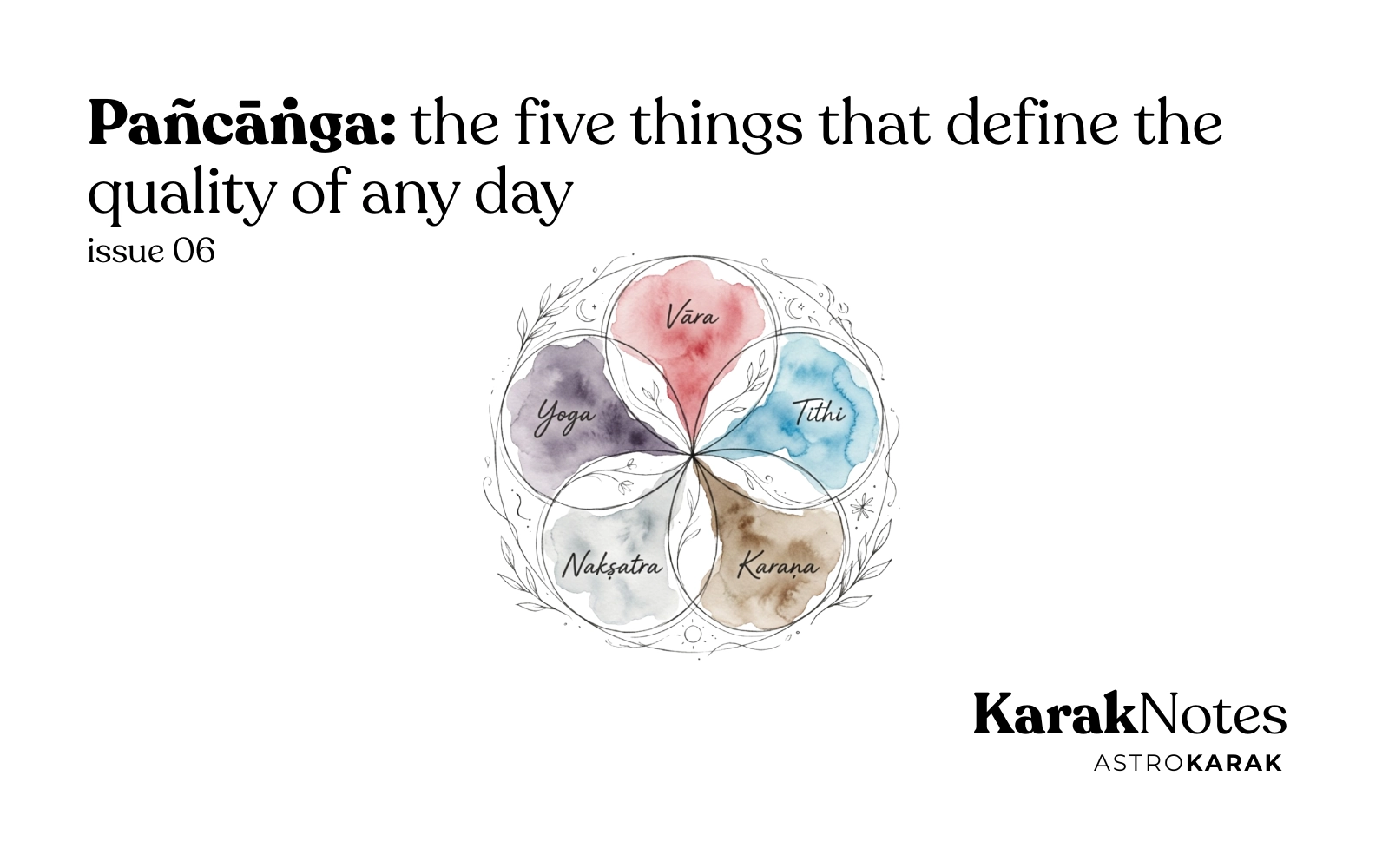
Pañcāṅga: The Five Limbs of Time
Every time you open Drik Panchang or any Jyotiṣa software and see the day's Tithi, Nakṣatra, Yoga, Karaṇa, and Vāra listed out: that listing is not administrative. Those five elements are the Pañcāṅga: the five-limbed body of time itself.
The word comes from Sanskrit: pañca means five, aṅga means limb or body part. Time, in this framework, is not a neutral container. It is a living entity with structure, quality, and consequence. The Pañcāṅga is how Jyotiṣa reads that quality.
Vāra (the day of the week)corresponds to the fire element. The Sun and Mars govern fire, and it is the Sun that drives the weekday cycle: Sunday for Sūrya, Monday for Candra, Tuesday for Maṅgal, and so on through Saturn's Saturday. Vāra governs your physical energy, vitality, and bodily strength. The planet ruling your birth Vāra acts as the primary energy source of your body, it is the one that determines your baseline physical constitution, your fighting capacity, and your dharma at the most fundamental level.
Tithi (the lunar day)corresponds to the water element. This is the angular distance between the Sun and Moon, measured in 12-degree increments. Because the Moon moves faster than the Sun, the angle is constantly changing, which is why a Tithi does not align neatly with a clock day, and why the Tithi can change at any time of day rather than at midnight.
360° ÷ 30 Tithis = 12° per Tithi.
There are 30 Tithis in a lunar month: 15 in Śukla Pakṣa as the Moon waxes away from the Sun, 15 in Kṛṣṇa Pakṣa as it returns. Tithi governs the emotional body, relationships, romantic partnerships, and the fluid systems of life. The planet ruling your birth Tithi and its placement in your rāśi chart tells an astrologer a great deal about the quality of your emotional life and the nature of your relationships.
Let me give you an example: I have a client who has tithi Lord moon debilitated in Scorpio, and there has been a rocky past with relationships which still hasn’t ended and she regularly suffers between wrong choices of partner. The tithi lord can help determine, for a professional astrologer, about the quality of relationships in the life of an individual.
Karaṇa (half a Tithi)corresponds to the earth element. Each Tithi is divided into two equal halves, producing 11 Karaṇas in a cycle (7 movable, 4 fixed). Just as liquid dries into solid matter, Karaṇa represents the tangible, material dimension of life: work, wealth, career, and karma yoga. The planet governing your birth Karaṇa reveals the kind of work through which you are designed to create prosperity, and the house it occupies in your chart tells you in which domain of life that work needs to happen.
Nakṣatra (the lunar mansion)corresponds to the air element. Air means movement, and the Nakṣatra governs the direction of your life: the paths you take, the fortune you encounter, and your overall longevity. There are 27 Nakṣatras, each spanning 13°20' of the zodiac, and the Moon transits one roughly every day. Your birth Nakṣatra is determined by where the Moon was when you were born, and in Jyotiṣa this is one of the foundational data points for any reading.
Yoga (the luni-solar day)corresponds to the ether element: ākāśa, the subtlest of the five. It is calculated by adding the longitudes of the Sun and Moon and dividing by 13°20'. There are 27 Yogas, each with a name and quality. Some are considered highly auspicious (Siddhi, Amṛta, Śubha), others inauspicious (Vyatīpāta, Vaidhṛti). Yoga governs your intelligence, spiritual orientation, and the broader quality of your life… the ether that pervades everything.
All five elements are read at local sunrise. This is not ritual convention, sunrise marks the moment the body's internal systems synchronise with the solar cycle. The Pañcāṅga active at sunrise defines the quality of the entire day that follows. This is also why calculating the Pañcāṅga for New Delhi and applying it to someone in Chicago is technically incorrect: the sunrise, and therefore the active elements, are different for each location.
For Mundane events, check these parameters at sunrise. For your own chart:
The Pañcāṅga of your birth moment is not just a calendar entry. It is a diagnostic.The five elements active at the exact local time of your birth day map out the structural landscape of your life. Your Vāra lord tells an astrologer about your physical constitution. Your Tithi lord speaks to your emotional architecture and relationships. Your Karaṇa lord points to your career karma. Your Nakṣatra speaks to your fortune and direction. Your birth Yoga points to your intelligence and spiritual quality.
This is one of the deeper reasons why exact birth time matters so much in Jyotiṣa. The difference of even a few minutes can change which Tithi or Nakṣatra was active at the time of your birth, which changes the lords, which changes the diagnostic entirely. If you are uncertain about your birth time, the Pañcāṅga is one of the areas where rectification makes a real difference.
For daily use: look up the active Pañcāṅga elements each morning at drikpanchang.com which is accurate, free, and location-based. Note the Tithi, the Nakṣatra, and any special Yoga. The Tithi tells you the emotional quality of the day. The Nakṣatra indicates the overall direction and fortune. The Yoga gives you the day's spiritual and intellectual character. Over a few weeks of observation, patterns start to emerge that you cannot ignore.
check your chart
Look up the Nakṣatra active at your birth time on your birthday: this is your Janma Nakṣatra (birth lunar mansion). Enter your birth date, time and location in Drik Panchang or any other decent software, and look at the Nakṣatra field at the clock time of your birth. Note which Nakṣatra it is and which planet rules it in the Vimśottarī system. That ruling planet is your Vimśottarī Daśā system's starting point, and understanding its placement in your chart will tell you a great deal about the overall direction and timing of your life. Write to us if you find something that surprises you.
from the vault
This week, something a little different, not a reel but a playlist.
Around eight months ago the Astrokarak Instagram stories shared a Rāga chart: which classical Indian Rāgas correspond to which conditions: Rāga Bhairavī for insomnia, Rāga Darbārī for tension, Rāga Mālkauns for depression, and others. That story got an extraordinary response.
The tradition behind it is called Rāga Chikitsā (music therapy through Indian classical music) and it is not folk belief. The texts that document it are centuries old, and the mapping of specific Rāgas to specific physiological and psychological conditions is a documented feature of the Nāda Yoga tradition. Rāga Darbārī Kāṇāḍā, for instance, is traditionally attributed to Tansen and believed in the classical tradition to have been introduced to Hindustani music specifically to ease the mental tension of the court, its solemn, late-night character remains its defining quality. Research published in clinical journals has since documented the effects ofRāga Bhairavī on the parasympathetic nervous system, andRāga Darbārī has been used in hospital settings for anxiety and insomnia management.
The playlist I curated eight months ago is still live on Spotify. If you find yourself in one of the conditions listed, try it. Not as medicine, not as a substitute for proper care, but as what it is: sound that has been mapped to specific physiological and emotional frequencies for thousands of years.
The specific Rāga-to-condition mappings are drawn from the Rāga Chikitsā tradition. The associations for Darbārī (tension, heart), Bhairavī (insomnia), Mālkauns and Lalit (asthma), Bhūp (blood pressure), and others are consistent with documented traditional sources. Treat them as the tradition treats them: as observed patterns, not clinical prescriptions.
→ Listen: Astrokarak Rāga Healing Playlist

Why is this in a Jyotiṣa newsletter? Because Pañcāṅga this week involves sound. The Yoga limb, the ether element, ākāśa, is the domain of sound and vibration. In Vedic cosmology, ākāśa and nāda (sound) are inseparable. Music is, in the classical understanding, a direct tool for working on the quality of consciousness that Yoga governs.

→ Listen: Astrokarak Rāga Healing Playlist
a note from the week
Two things happened in the last few days that I want to share.
The first: it is very rare in consultations that someone actually asks about their past lives or the D60 chart. One such conversation happened this week. We discussed the D60, and the chart revealed that this person had been a saint, brahman, healer, and astrologer across most of his past lives. What made it striking was what came after: he told me that a few years ago he had a past-life regression session with a specialist, and what we had discussed in the reading was exactly what he had seen in that session. Two separate methods, two separate moments, the same picture. I keep thinking about the nature of time as the fourth dimension, that it is not a line but a structure you can move through, and Jyotiṣa is one of the tools that lets you do that.
A few minutes after that call ended, I was watching a YouTube channel I have followed for a long time: a travel creator named Raunaq (Monkey Magic on YouTube). He does remarkable things: walking from the origin of the Gaṅgā to where it meets the sea, the Narmadā Parikramā, crossing India without money. What he encounters on these journeys is never random, the people, the timing, the connections. Watching his content that day after the D60 conversation, something struck me about the pattern, nimitta if you remember from one of our previous issues. A nomad healer making journeys that are not really about geography. Make of that what you will.
The second: several of you who replied to Issue #5 said the weekly calendar is useful enough to screenshot and save. I am very glad. It gets hectic at times, which is why you are reading this Monday. But you know, I just couldn’t send it until I was satisfied with this issue. Thank you for reading and staying connected.
See you next Sunday.
Pranjal
KarakNotes by Astrokarak · Ahmedabad, India