Issue #7 · April 20-26, 2026 ·Vaiśākha Śukla Pakṣa
Good Morning!
Read the previous issues here: Issue #1 · Issue #2 · Issue #3 · Issue #4 · Issue #5 · Issue #6
ākāśa / the week at a glance

The week, running from Monday April 20 to Sunday April 26 is, without exaggeration, one of the most devotionally loaded stretches of the Vaiśākha calendar.
Monday, April 20: Akṣaya Tṛtīyā
The Moon opens the week in Rohiṇī nakṣatra (until 2:08 AM Tuesday), with Tṛtīyā tithi running until 7:27 AM, after which Chaturthi begins. Saubhāgya Yoga holds through the afternoon. The day carries Sarvartha Siddhi Yoga for the full day, which is one of the classical markers for initiations, new undertakings, and acts whose effects are meant to endure.
Akṣaya Tṛtīyā is celebrated as a day of imperishable (akṣaya: that which does not diminish) results. The Bhaviṣya Purāṇa records it as the day Kṛtayuga began. The Mahābhārata mentions it as one of the four self-illumined days of the year, days that require no further muhūrta verification, the day itself is considered inherently auspicious from sunrise. Classical texts, including theHemādri Caturvarga Cintāmaṇi, prescribedāna, japa, and pitṛ tarpana on this day because the merit of acts performed here does not exhaust.
What you can do: This is a genuine day for beginning something that matters, maybe the beginning of a course of study, a new discipline, a vow you have been postponing, it can be anything varying from person to person. If you have been holding back on something important out of doubt about timing, Monday morning after sunrise is your answer. Gold is traditionally purchased on Akṣaya Tṛtīyā because gold was used to represent permanence… the underlying idea is that what you put into motion today carries a quality that does not decay.
Tuesday, April 21: Śaṅkara Jayantī
The Moon moves from Mṛgaśīrā into Ārdrā(around 11:58 PM Tuesday). The tithi transitions from Pañcamī through Ṣaṣṭhī across the day.
Śaṅkara Jayantī marks the birth anniversary of Ādi Śaṅkarācārya, the Indian philosopher who walked across the subcontinent in the 8th century CE and restructured the intellectual and spiritual architecture of the tradition. He is credited with composing the Soundarya Laharī, the Vivekacūḍāmaṇi, and with consolidating Advaita Vedānta into a coherent living philosophy. He also established four maṭhas at Śṛṅgeri, Dvārakā, Puri, and Jyotirmaṭha, which continue to function today.

Whether or not you practice Advaita philosophy, Śaṅkara's life carries a quality that is worth stopping for. I would like to share a clip which I like, an anecdote from Śaṅkara's life: A moment that exposed the last illusion
Additionally, either now or on 21st, I recommend listening to this as well: Nirvana Shatakam. You can choose to read it, but I highly recommend Nirvana Shatakam.
What you can do: Chant Om Namaḥ Śivāya 108 times on Tuesday. The Pañcākṣarī mantra is Śaṅkara's own prescription. If you have ever wanted to begin reading the Soundarya Laharī or the Śiva Mahimna Stotra or anything which feels relevant to you, Tuesday is the day.
Thursday, April 23: Gaṅgā Saptamī and Guru Pūṣya Yoga
This is thesingle most significant day of the week, and a strong candidate for the most auspicious day of this month.
Gaṅgā Saptamīmarks the day the river Gaṅgā is said to have descended from Svarga to Bhūloka, carried in the matted locks of Śiva before reaching the earth. The Skanda Purāṇa describes the Gaṅgā as Mokṣadāyinī, the one who grants liberation. Snāna(bathing),dāna(charity), andpitṛ tarpana(ancestral offering) performed on Gaṅgā Saptamī carry extraordinary weight in the tradition. For the Saptamī tithi, Surya Dev is the deity to worship, which adds a solar, clarifying quality to the day. But remember, for the Pañcāṅga study, Saturnis considered the planetary ruler ofSaptamītithi.
On the same Thursday, Guru Pūṣya Yoga occurs: the Moon enters Puṣya nakṣatra at approximately 8:57 PM (IST), and this coincides with Guruvāra. This combination, Guru's day meeting Puṣya, is one of the rarest and most celebrated yogas in the entire Jyotiṣa calendar. The Bṛhat Saṃhitā of Varāhamihira treats Puṣya as the most auspicious of all nakṣatras for initiations. Classical texts consistently recommend Puṣya for beginning any course of learning, for consecrating deities, for planting, and for important transitions. When Puṣya falls on Guruvāra, the effect is amplified as the nakṣatra and the weekday are governed by the same Graha, Bṛhaspati. The Amṛta Siddhi Yoga runs from 8:57 PM Thursday to 5:47 AM Friday. Sarvartha Siddhi Yoga holds for the entire day.
What you can do: If you have been thinking about beginning a study of Jyotiṣa, or any Vedic subject, Thursday evening after 8:57 PM (New Delhi Time but check your local time via Drik Panchang) is the precise window to formally begin. Guru Pūṣya Yoga is used classically to initiate disciples into study. Light a lamp. Place your books in front of it. Begin.
Saturday, April 25: Sītā Navamī
The Moon enters Maghā nakṣatra(around 8:03 PM Saturday), transitioning into Daśamī. Sītā Navamī marks the birth anniversary of Maa Sītā, born from the earth during Janaka's ploughing of the field. The Vālmīki Rāmāyaṇaand Adhyātma Rāmāyaṇa both describe her as an aspect of Mahālakṣmī who took human birth.
What is worth sitting with on this day is Sītā's nature as classical Indian literature understands it:dharmic endurance, a quality that does not break under external pressure. Her significance is not only devotional, but also a study inholding one's centre under sustained difficulty.
The week's overall quality: begin, worship, give, study. If there is a week this year to be deliberate about your inner life, this is a strong candidate.
mundane notes
This is the harder half of the same week. Four sacred days fall in these seven, and simultaneously this is the climax of the January to April 2026 crisis cycle I have been tracking across the last few issues. Both are true. The calendar is at its most auspicious in the week the grahas are at their most volatile. That tension is the story of this week.

A triple Graha Yuddha in Mīna. Mars, Saturn, and Mercury are all locked within 1° of approximately 13° Pisces. Three simultaneous planetary wars at one degree. This is genuinely rare. Mars wins against Saturn on April 20. Mercury wins against Saturn on April 21. Mercury wins against Mars on April 21. If you read Issue #3 on Graha Yuddha, you already know what the losing planet's significations lose. Applied here at the mundane level, Saturn is the most defeated: structural authority, institutions, and diplomacy. Mars is frustrated but effective. Mercury, though debilitated, wins its wars, which is a strange and unstable outcome.
Mercury debilitated, in Parivartana with Jupiter. Budha sits debilitated in Mīna while Guru sits in Mithuna. The two are in Parivartana Yoga, a sign exchange. That creates a feedback loop where Mercury's compromised cognition is running through Jupiter's wisdom. What is said and what is heard diverge sharply this week. Negotiations, official statements, media reporting, expect distortion at each pass.

Ketu in Maghā. The classical "fall of kings" signature. Leadership crises, regime instability, and power vacuums remain active through the week.
April 20 to 22: the red zone. April 20 is the single most dangerous date of the full January to April cycle. Formal war declarations or expansions, large-scale attacks or accidents, collapse of peace processes, and sudden global shock events all fall within the probability window. Financial markets are expected to fall sharply. Gold and oil surge. Earthquake, tsunami, and structural disaster risk at maximum. April 21 and 22 are not separate events. They are the aftershock of April 20, with diplomacy collapsing under debilitated Mercury and cyber disruptions likely through Wednesday.
April 23: the silence. A pivotal turning point. The noise begins to recede. The US-Iran conflict window (April 21 to 23) reaches an inflection point. Once this phase ends, de-escalation begins.
For a while.

April 24 to 26: the exhale. Tensions visibly de-escalate, though the broader Mars in Pisces window continues until May 12. A residual "sudden undesirable event" flag remains for April 24 to 28. The intensity drops, but vigilance holds. Writing, planning, presentations, and problem-solving improve as Mars separates from Saturn's grip. The most bullish 12-day window for markets runs April 19 to May 1, with post-April 25 more likely to produce bullish returns. The Mercury-Mars bearish track-record window (April 14 to 26) closes on Sunday.
Weekly rating in mundane:
- April 20 (Mon) - Extreme. Triple planetary war exact. War peak. Red alert.
- April 21 (Tue) - Extreme. Double Graha Yuddha. Diplomacy collapses.
- April 22 (Wed) - High. War window closing. Aftermath. Cyber risks.
- April 23 (Thu) - Elevated. Silence. Financial volatility. Turning point.
- April 24 (Fri) - Moderate. War alert ends. Grounding begins.
- April 25 (Sat) - Moderate to positive. Markets bullish. Innovation window opens.
- April 26 (Sun) - Easing. Peace returns slowly. May not be permanent.
The practical read: the first three days of this week are for observation, not initiative.The festivals on Monday (Akṣaya Tṛtīyā) and Tuesday (Śaṅkara Jayantī) hold their own authority regardless of the mundane weather, and japa, dāna, snāna, and ancestral rites on these days still carry their traditional weight. But anything that involves public engagement, financial movement, or high-stakes negotiation should wait. Thursday's Guru Pūṣya Yoga, landing exactly as the mundane silence arrives, is the structural pivot point of the week. From Friday onward the sky loosens and the weekend's Sītā Navamī closes the week on steadier ground.
The next major mundane spike after this one does not come until November 16 to 17, 2026. Use this week carefully. The window for the next one is wide.
one concept, explained
Cārakāraka: The Soul's Autobiography in Eight Planets
Most people who have had their chart read have heard the word "Kāraka" at least once, and the readers of this newsletter have definitely heard it. Kāraka means significator. In the Parāśarī system, certain planets carry fixed significations across all charts: Sūrya signifies father and authority, Candra signifies mother and mind, Śukra signifies marriage and beauty. These are Naisargika Kārakas, natural significators, permanent and universal.
The Jaiminī system introduces something structurally different. Something that is not universal but individual. Something that changes from chart to chart and is unique to each person. It is called the Cārakāraka system (Charakaraka), and understanding it can change the interpretation you may have.
The word Cāra means moving, variable, or mutable. Cārakāraka therefore means a significator that moves, that is not fixed but shifts depending on the actual degrees of the planets in your specific chart. In the Parāśarī system, Guru is always the Kāraka for children. In the Jaiminī Cārakāraka system, any planet can be the Kāraka for children, depending on where it sits in your nativity.
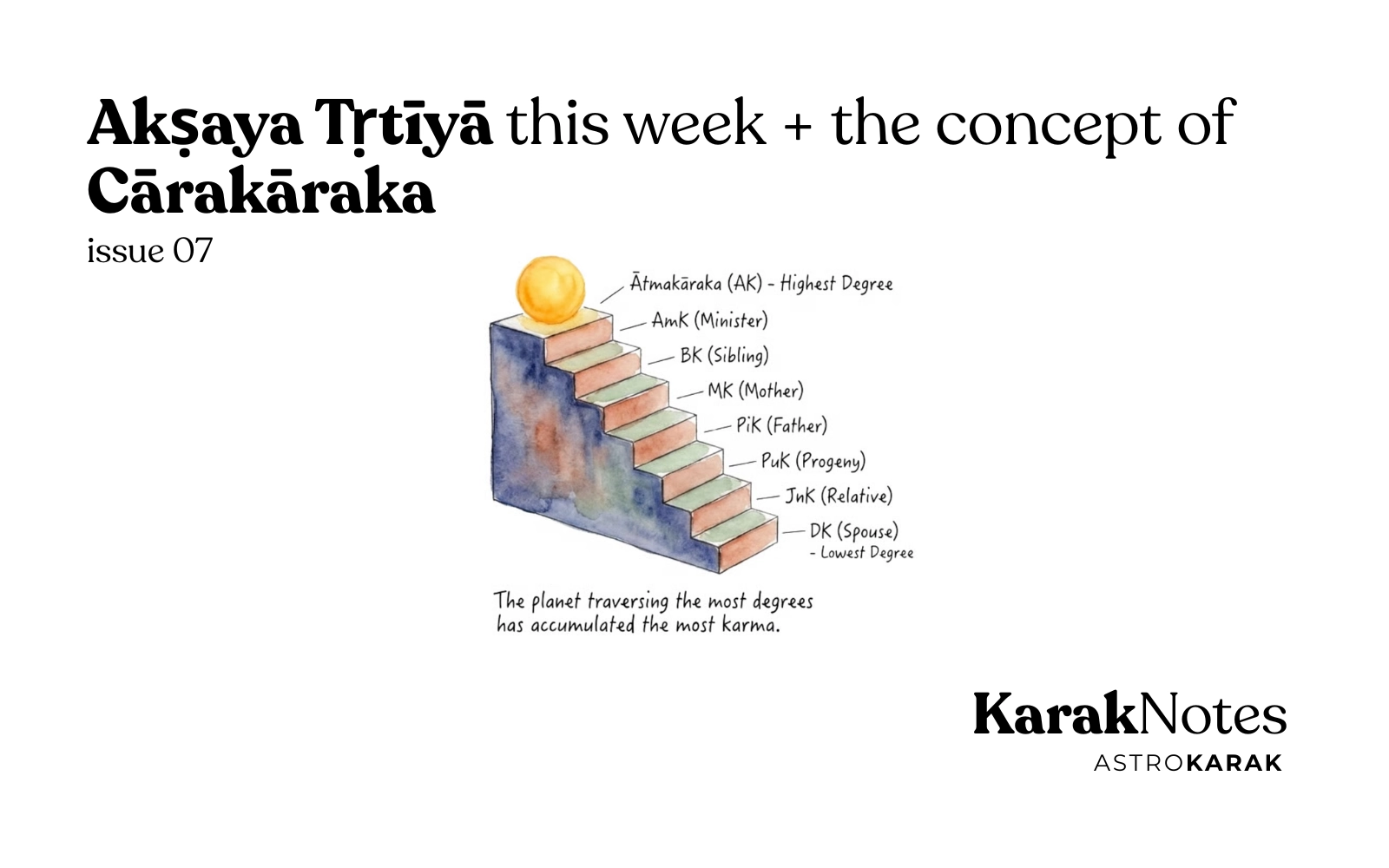
Here is the mechanism. In the Jaiminī Sūtras, Ṛṣi Jaiminī prescribes that eight Grahas, (or seven, depending on the schema, more on this shortly) excluding Ketu, are ranked by the degrees they have traversed within their current sign. The planet that has traversed the most degrees in its sign becomes the Ātmakāraka. The one with the second highest traversal becomes the Amātyakāraka. The third becomes the Bhrātṛkāraka. And so on through a fixed sequence of eight roles.
The eight Cārakārakas and what they represent:
Ātmakāraka (AK) the soul significator. The most important of all. This planet represents what the soul has chosen to learn in this lifetime. The house it occupies in the Navāṁśa (D9) chart, called the Kārakāṁśa, is one of the most powerful indicators in the entire Jaiminī system. What you are here to master, to struggle with, and ultimately to transcend is written in the Ātmakāraka and its Kārakāṁśa position.
Amātyakāraka (AmK) the minister significator. Governs career, profession, and the planet most responsible for the direction of your worldly life. Where Ātmakāraka shows the soul's purpose, Amātyakāraka shows the vehicle through which that purpose is expressed in the world.
Bhrātṛkāraka (BK) the sibling significator. Governs brothers, courage, and effort.
Mātṛkāraka (MK) the mother significator. Governs the mother, property, and emotional foundation.
Pitṛkāraka (PiK) the father significator. Governs the father and mentors.
Putrakāraka (PK) the progeny significator. Governs children and creative intelligence.
Gñātikāraka (GK) the relative significator. Governs extended family, disputes, and disease.
Dārakāraka (DK) the spouse significator. Governs marriage, partnership, and the nature of intimate relationships.
There is a genuine classical debate about whether the Cārakāraka system uses seven planets (excluding Rāhu entirely) or eight (including Rāhu as a special indicator). Jaiminī Sūtras themselves permit both readings. Parampara lineages differ. In the system I follow, Rāhu is included as the eighth Kāraka, but with an important inversion: Rāhu's degree is measured as 30 minus its actual traversal, because the nodes move in the retrograde direction.
The planet that becomes your Ātmakāraka is not randomly assigned. In the Jaiminī understanding, the planet that has traversed the most degrees has spent the most time in a sign and it has, in the language of the system, "accumulated the most karma" in that sign. It is the planet most deeply embedded in the texture of your current incarnation. That is why it becomes the soul significator.

Every Ātmakāraka carries its own quality.
- Sūrya as Ātmakāraka indicates a soul working on lessons of authority, ego, and the father.
- Candra as AK points to lessons around the mind, the mother, and emotional stability.
- Maṅgal as AK suggests themes of courage, aggression, and controlled action, a soul that has come to learn what it means to act without reactivity.
- Budha as AK gives themes of analysis, communication, and discernment.
- Guru as AK, which is relatively rare, gives themes of wisdom, teaching, and the dharmic life lived with genuine expansion.
- Śukra as AK points to desire, relationship, and the transformation of attachment into devotion.
- Śani as AK is perhaps the most demanding, gives themes of patience, hardwork, karma, and the hard, necessary work of earning rather than inheriting.
- Rāhu as AK shows the soul has chosen challenging material circumstances as a path for accelerated spiritual growth, as it is a natural malefic.

The Kārakāṁśa is where this becomes practically applicable. Once you identify the Ātmakāraka, you find which sign it occupies in the Navāṁśa. That Navāṁśa sign becomes the Kārakāṁśa Lagna, a special ascendant overlaid onto the Navāṁśa chart. The planets that join or aspect the Kārakāṁśa, the sign's lord and the natural significations of the Kārakāṁśa sign together create a picture of yoursoul's deepest purpose,its most significant obstacles, andthe arena in which its most important growth happens.
I have read charts where someone's professional narrative made no sense from the Lagna chart alone, but the moment the Kārakāṁśa was examined, the entire trajectory became clear. A person with Śukra as AK in the Kārakāṁśa of Vṛṣabha will have a life shaped by aesthetics, beauty, and the learning of detachment from pleasure. A person with Śani as AK in Makar's Kārakāṁśa will face a life of structured labour, public responsibility, and the slow, patient accumulation of genuine authority.
The Jaiminī Sūtras are not long. Chapter One, Pāda One contains the foundational sūtras on the Cārakāraka system. The commentary tradition on these sūtras is where the depth lies.
If you want to identify your own Cārakārakas, pull up your chart in any Jyotiṣa software (deva.guru or Jagannātha Hora works well, and it is free), look for the Graha Info or the Jaiminī section, and find the column listing AK, AmK, BK, MK, PiK, PK, GK, DK. The planet listed as AK is the one to start with. Find where it sits in your Navāṁśa. That sign is the Kārakāṁśa. Begin there.
from the vault
A newer selection this week. Over the past few weeks I have been building out aDaśā Timing serieson Instagram, designed to sit alongside the blog posts I have been writing on the same topic.Three posts from the series are worth reading this week, in order:
Post 1:The Daśā System: How Planetary Timing WorksThe foundational piece. What is a Mahādaśā, how the 120-year Vimśottarī cycle is structured, and why the chart without the Daśā is a photograph with no calendar. Read the full blog atastrokarak.com/blog/dasha-system-vedic-astrology.
Post 2:Vimśottarī Daśā ExplainedOne level deeper: how to read the Daśā lord's natal placement to understand what a period will actually deliver, and what the Antardaśā layering adds. Read the full blog atastrokarak.com/blog/vimshottari-dasha.
Post 3:The Moon's Role in Daśā TimingThe question most students never ask: why does the Moon seed the entire timing sequence? What doesmanashave to do with when karma activates? This is the most conceptually interesting of the three, and the shortest path to understanding why the Daśā system is built the way it is, rather than just how it works. Blog:astrokarak.com/blog/moon-role-dasha-timing
If you have only a few minutes, start with Post 3. It is the shortest path to understanding why the Daśā system is built the way it is, not just how it works. More on the way!

closing
Ravivāra belongs to Sūrya. The Sūrya Siddhānta opens with the declaration that time itself kāla is without beginning and without end, but that its measurable form, its structured, knowable quality, is made possible by the motion of the grahas. Sūrya is the first among them. The week exists because of the Sun. The year exists because of the Sun. The entire framework of pañcāṅga, the five limbs we discussed in Issue #6, is ultimately anchored in solar motion. Just wanted to mention this today.
The previous 6 issues are and will remain publically available. Issue 7 onwards, which is this one, we are exclsuively email-only.
If this issue was useful, the single best thing you can do is forward it to one person who would get real value from it. The subscribe link isastrokarak.beehiiv.com.For consultations, courses, and ebooks,astrokarak.com.
Best Regards,
Pranjal (& the Astrokarak team)
PS: If you have any interesting observations, queries, or just want to give feedback, reply to this email, I read all mails.
Astrokarak | Ahmedabad, India